The mid-market manufacturing and building products sector ($10M–$100M ARR) is currently facing a silent crisis. While market demand remains robust, traditional operational structures are hitting a hard ceiling. It isn’t a lack of orders throttling growth; it is the massive friction living quietly between front-end sales channels and back-end factory floors.
Recent macroeconomic data reveals a stark divide between industrial companies still relying on manual handoffs and those leveraging structured workflow automation.
The Scale of the "Data Deficit"
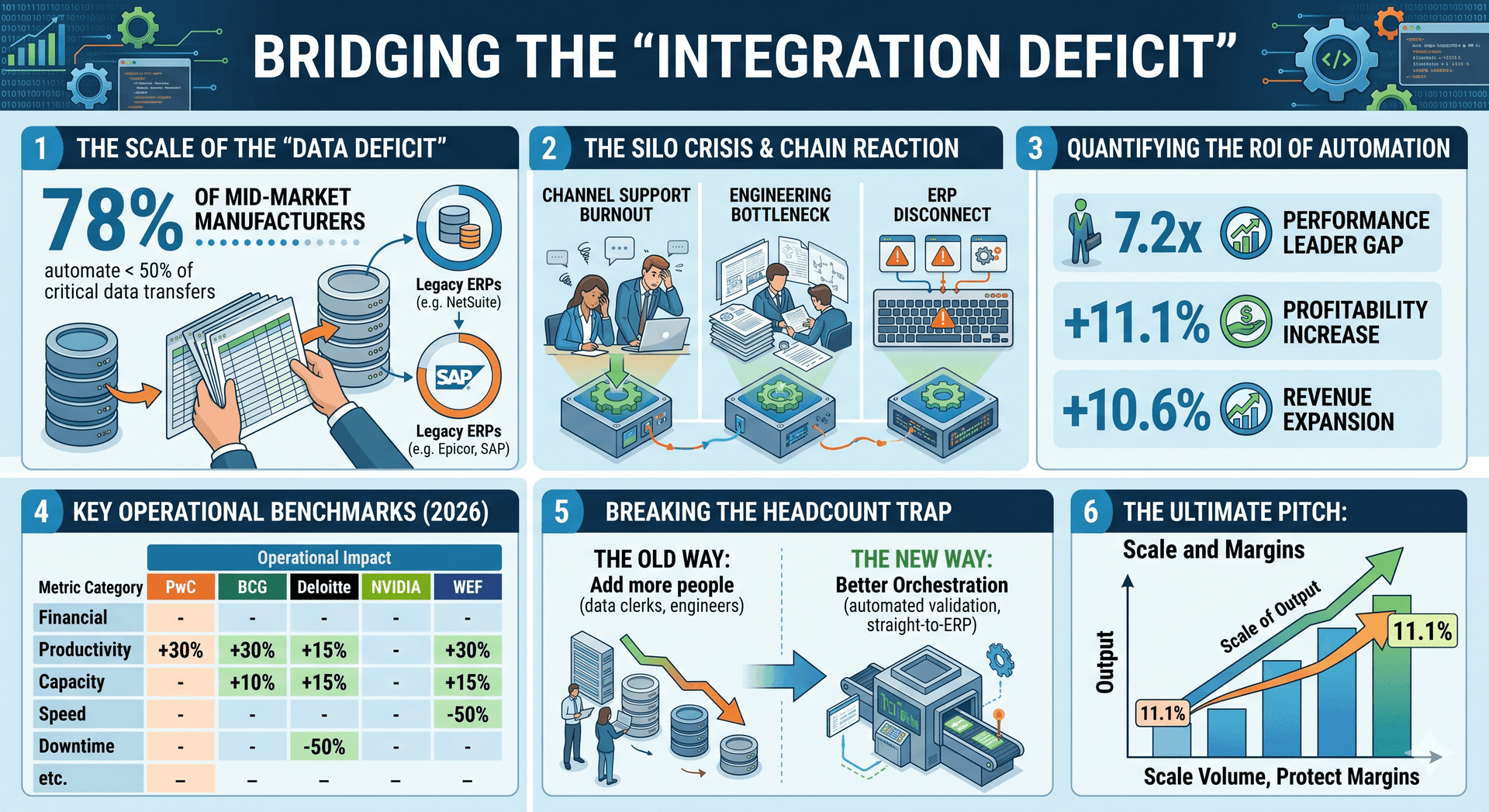
For many industrial executives, administrative overhead has become the ultimate growth constraint. Data from Deloitte’s 2026 Smart Manufacturing Data study exposes a critical vulnerability: 78% of mid-market manufacturers automate less than half of their critical data transfers.
In practice, this creates an environment heavily reliant on manual spreadsheet data entry and constant human intervention. When a dealer or architect submits a complex request for proposal (RFQ), the data frequently enters an internal black hole:
- Channel Support Burnout: Inside sales teams spend excessive hours manually verifying SKU variations, pricing configurations, and checking availability.
- The Engineering Bottleneck: Highly paid sales engineers spend up to 30% of their capacity auditing blueprints and manually translating custom specifications into a Bill of Materials (BOM).
- The ERP Disconnect: Because front-end CRMs or sales spreadsheets do not communicate natively with back-end ERP systems (such as Epicor, NetSuite, or SAP), data must be re-typed. This manual chain introduces a 1.5% to 3% material waste rate on the factory floor due to simple human entry typos.
According to cross-industry operational studies, this lack of API integration between sales pipelines and plant systems is the root cause of 66% of all production scheduling and forecasting bottlenecks.
Quantifying the ROI of Industrial Automation
The financial and operational argument for eliminating these manual silos is no longer theoretical. Prestigious 2026 research benchmarks outline exactly how much margin is recovered when manufacturers replace manual handoffs with automated orchestration:
Table 1. 2026 Industrial Automation Benchmarks
| Business Performance Indicator | Prestigious Research Source | Verified Operational Impact |
| Combined Financial Outperformance | PwC 2026 AI Performance Study | 7.2x Performance Leader Gap Leaders outpace laggards by over 700% in combined revenue and margin gains. |
| Bottom-Line Margins | PwC 2026 AI Performance Study | +11.1% Profitability Increase Driven directly by the elimination of administrative waste. |
| Top-Line Revenue Expansion | PwC 2026 AI Performance Study | +10.6% Growth Achieved by slashing quoting speeds to win competitive B2B contracts first. |
| Baseline Shop Floor Productivity | Boston Consulting Group (BCG) | +30% Productivity Boost Unlocked by integrating automation directly into core operational workflows. |
| Plant Capacity Optimization | Deloitte 2026 Manufacturing Outlook | +15% Hidden Capacity Unlocked Enables volume scaling without requiring capital expenditures on new machinery. |
| Production Line Throughput | NVIDIA 2026 State of AI Report | +20% Throughput Increase Resulting from automated design verifications and tighter data cycles. |
| Unplanned Factory Downtime | World Economic Forum / Deloitte | -50% Reduction in Downtime Automated processes catch routing and scheduling errors before they freeze lines. |
Source: ConTech by MindPal, 2026
Breaking the Headcount Trap
When order volumes spike, the traditional reflex for a mid-market manufacturer has been to hire—more data-entry clerks, more inside sales reps, and more estimating assistants. However, in a tight labor market, this "headcount trap" severely dilutes profitability.
The data proves that the solution is not more staff, but better orchestration.
By establishing seamless, automated bridges that instantly validate incoming dealer configurations, audit specifications, and push error-free data straight to the ERP, manufacturers can compress their quoting cycles from 14 days down to under 2 hours. This optimization allows companies to capture the 15% hidden factory capacity highlighted by Deloitte, scaling overall volume while fully protecting and expanding their 11.1% bottom-line margins.
Tom Teluk
ConTech by MindPal
PR & Communication Head