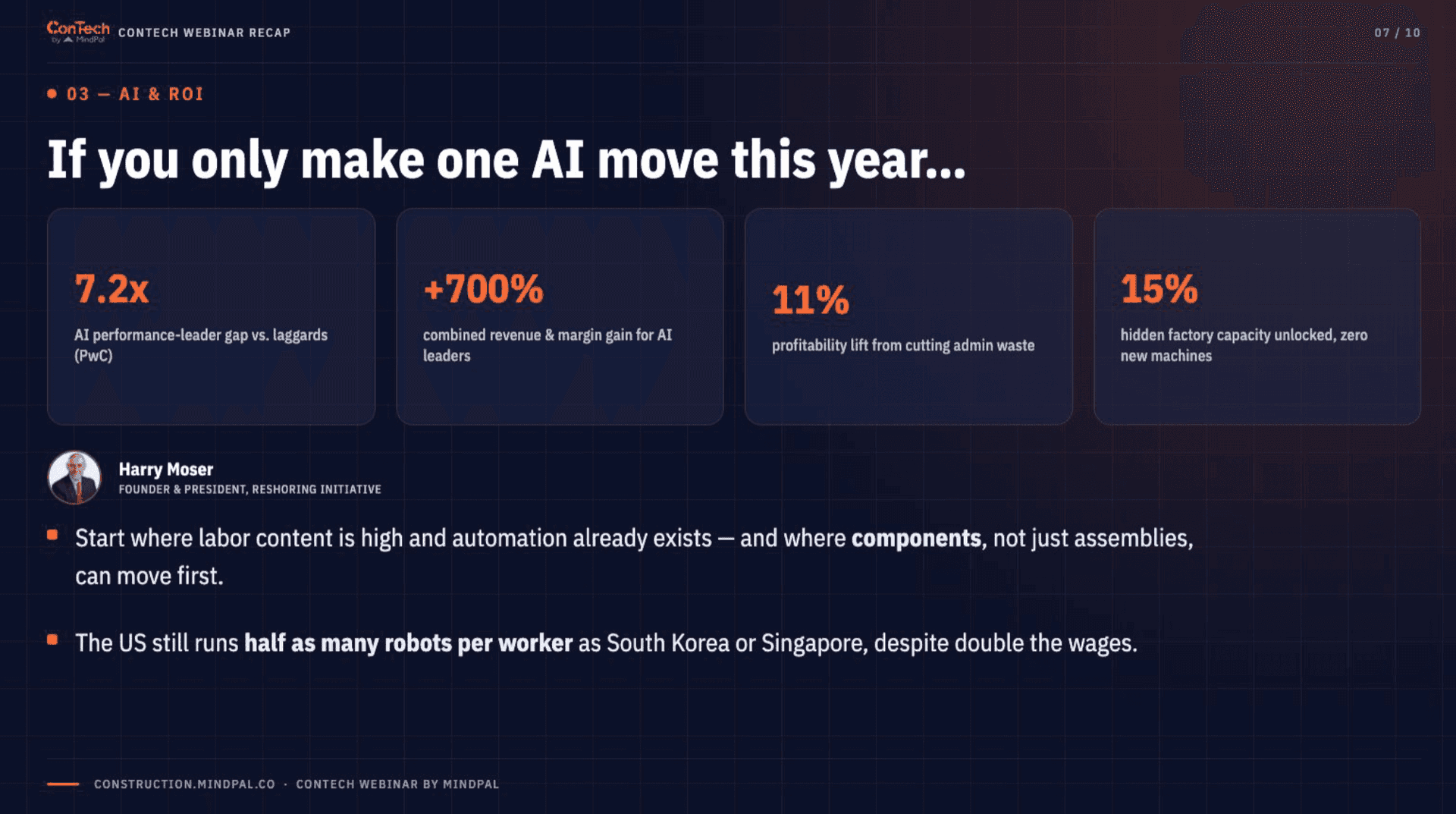
Despite awareness barriers, pioneers of AI implementation in the United States are reporting spectacular financial and operational results. In 2024–2025, investments in construction technology reached a "tipping point," and the cumulative value of ConTech investments exceeded 50 billion USD.
Case Studies and Financial Efficiency test
Companies like Bechtel and Skanska are setting standards for using Large Language Models (LLM) and AI assistants to manage vast technical documentation. Bechtel, operating on thousands of pages of equipment manuals and protocols, created its own LLM model that allows users to ask questions in natural language and instantly generate punch lists, shortening information retrieval time from days to minutes.
| Technology / Company | Application | Effect / Savings |
| BIM (Building Information Modeling) | Coordination and clash detection | 48% fewer reworks, 55% higher collaboration efficiency. |
| Grade Tech Power Services | Material management and downtime reduction | $90,000 savings on one project; $3,500/day in avoided downtime costs. |
| 3D Printing (Concrete) | Structural erection automation | 50-70% reduction in labor demand; 40% less waste. |
| Drones / Computer Vision | Progress monitoring and inspections | 60% reduction in inspection time; 30% savings in labor costs. |
| Daisy AI / Autodesk | Optimization of timber floor layouts | Full design automation, reduction of design errors. |
Source: MindPal.co, 2026
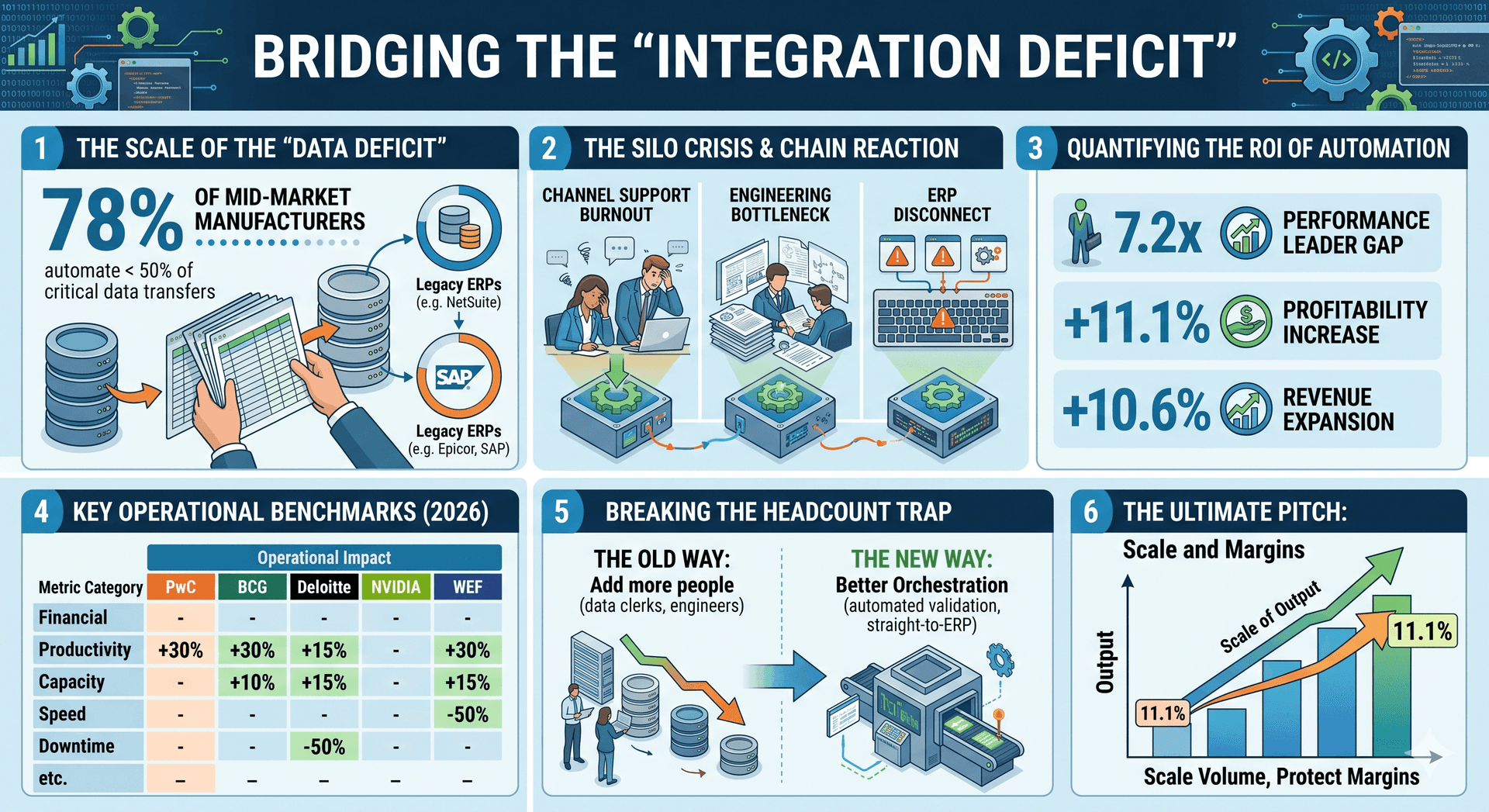
Crucial data comes from a 2024 Construction Executive report, showing that every additional technological solution implemented generates an average 1.14% increase in expected revenue. For a company with revenues of 100 million USD, this means an increase of 1.14 million USD per year. AI-driven companies record 2.5 times higher revenue growth and 2.4 times higher productivity compared to competitors not using these tools.
Phases of Achieving Return on Investment (ROI)
ROI on AI in construction is not instantaneous—a key takeaway for budget planning for 2025–2026. Analysis indicates three main phases:
- Immediate Efficiency (0–6 months): Automation of routine office tasks like invoice entry, reporting, and scheduling. Back-office improvements shorten payment cycles and improve cash flow visibility.
- Emerging Patterns (6–12 months): Use of video analytics and sensors to improve safety, and integration of reality capture with BIM models for early clash detection, drastically reducing costly changes during construction.
- Strategic Forecasting (12+ months): Systems learn from historical project data, allowing for more precise cost and margin forecasting, reduction of contingency spending, and better resource allocation across the entire order portfolio.
The average time for full ROI on AI currently ranges from 1 to 2 years, longer than the typical 7–12 months for simple IT technologies, but cumulative long-term operational benefits are significantly higher.
Robotics and ConTech Market: Investments and Forecasts for 2025–2026
The year 2025 brought an unprecedented influx of capital into the construction robotics sector. In the first three quarters of 2025, venture capital funds invested 1.36 billion USD in companies within this industry—a 125% increase over the entirety of 2024. This capital injection is driving the commercialization of solutions that were recently in the laboratory testing phase.
Market Dynamics and Key Transactions
The AI market in construction is expected to reach a value of 6.2 billion USD in 2026, with a forecast to grow to 32 billion USD by 2033 (CAGR of 26.4%). Software remains the dominant segment (63.5% market share), but AI implementation services are the fastest-growing area due to the immense complexity of data integration.
Notable transactions at the end of 2025 include:
- PermitFlow: 54 million USD for an AI platform to automate building permits.
- Attentive.AI (Beam AI): 30.5 million USD for automated takeoff software.
- Gravis Robotics: 23 million USD for scaling autonomous construction systems.
- Unlimited Industries: 12 million USD for generative design focused on cost and efficiency optimization.
Investors from Zacua Ventures point out that the foundation for success in 2026 is the ability of startups to implement real solutions on construction sites rather than just presenting theoretical model capabilities. The greatest interest lies in "Agentic AI" and physical robotics addressing the acute labor shortage.
Construction Site Robotization: From Vision to Reality
In 2026, construction robotics is no longer just a trade show "novelty". Real-world implementations include:
- Rebar Tying and Masonry: Robots performing repetitive, heavy physical work, resulting in labor time savings of 30-50%.
- Solar Installations: Autonomous systems for earthworks and panel mounting on large-scale solar farms.
- Reality Capture: Autonomous scanning of construction sites (e.g., Boston Dynamics' Spot robots) for daily verification of progress against the design model.
Construction as an Economic Engine and the Labor Crisis
Construction accounts for approximately 14% of global GDP, which in the U.S. translates to a sector employing millions and generating massive demand for materials and services. However, the industry suffers from a "productivity problem"—for years, this indicator has stagnated or grown minimally (1.3% annually), while a rate of 2.7% is required to meet 2040 market growth forecasts.
Employment Statistics and Wage Pressure
The staffing crisis has become the primary driver of automation. In January 2026, average hourly earnings for construction workers in the U.S. rose to a record $40.55, reflecting the desperate fight for talent.
| Staffing Indicator | 2025/2026 Data | Source |
| New workers needed in 2026 | ~349,000 | ABC |
| Percentage of firms reporting recruitment difficulties | 92% | AGC |
| Project delays due to lack of staff | 45% | AGC |
| Share of workers aged 55+ | 26% | St. Louis Fed |
| Unfilled job openings (March 2025) | ~449,000 | St. Louis Fed |
Source: MindPal.co, 2026
This demographic collision—mass retirement of experienced specialists combined with a lack of incoming young talent—means digital transformation is no longer a choice but a condition for survival. AI is viewed not as a tool for workforce reduction, but as a way to "fill" missing capacity and transfer the knowledge of departing experts to younger generations via decision-support systems.
Breakthrough Innovations: Agentic AI and Generative Design
The biggest technological trend of the 2025/2026 turn is the shift from "assistive" AI to "agentic" AI. Traditional AI tools analyzed data and suggested solutions; AI agents can take autonomous actions within defined processes.
Evolution of Agentic Systems
According to Gartner forecasts, by the end of 2026, about 40% of enterprise applications will include task-specific AI agents. In construction, this manifests through systems managing site logistics:
- Automated MEP Coordination (Mechanical, Electrical, Plumbing): AI systems can independently detect clashes in installation designs and suggest optimal routing for pipes or cables, cutting coordination time in half.
- Dynamic Scheduling: Algorithms that adjust the entire construction schedule in real-time in the event of material delivery delays or weather changes, simulating thousands of "what if" scenarios.
- Automated HSE Inspections: Computer vision systems connected to site cameras automatically identify missing Personal Protective Equipment (PPE) and send notifications to safety managers.
Generative Design and Prefabrication
In 2026, prefabrication and modular construction are gaining importance as they allow work processes to move to factories where AI can optimize material cutting and assembly with millimeter precision. Generative design allows for the creation of thousands of building design variants, each evaluated for cost, energy consumption, and buildability, reducing material waste by up to 40%.
Industry Anecdote: From Bricklayer to Director
In the 2025 ConTech environment, a metaphor gained popularity that perfectly illustrates the mental shift required from industry leaders. Traditionally, the role of an engineer or project manager was compared to a bricklayer—someone who must personally oversee the placement of every brick, precisely defining every logical step and controlling every workflow.
In the age of Agentic AI, the leader's role is evolving into that of a Director. As Google experts and ConTech leaders note, your task is no longer to write explicit code for every action or manually check every report. Instead, you "set the stage" (define instructions and goals), "cast the actors" (select the right tools and APIs), and "provide context" (project data). This transition from controlling logic to governing autonomous systems is the greatest psychological challenge for management, who must learn to trust algorithms making real-time decisions.
Another interesting story concerns "Spot the Dog"—the robotic dog from Boston Dynamics, which on one large U.S. construction site became not just a laser scanning tool, but a barometer of innovation culture. Initially treated as a "toy" or a threat, after three months of work, it was "adopted" by the crew as an essential team member that takes on the most tedious and dangerous inspection tasks at night, allowing engineers to focus on problem-solving in the morning.
Summary and Outlook for 2026–2030
Trend analysis for 2026 indicates that the digitization of construction in the United States has ceased to be an "optional extra" and has become a strategic necessity. Investments in data centers (driven by AI demand) and energy infrastructure will be the primary engine for ConTech firms.
Key Takeaways for the Sector:
- Pressure on Data: Construction firms must invest in cleaning and structuring their historical data to fully leverage the potential of generative AI. Without a "digital foundation," even the most expensive AI systems will generate hallucinations.
- BIM Standard: By the end of 2026, Digital Project Delivery (DPD) and BIM will become the contractual standard for most large projects, forcing medium-sized firms to quickly modernize their tech stacks.
- Sustainability: AI will become a key tool in reducing carbon emissions (the construction industry accounts for ~37-39% of global emissions). Algorithms optimizing cement and steel usage will be critical for meeting new regulatory requirements.
Construction in the U.S. in 2026 is an industry in a state of ferment. While it still lags behind finance in terms of automation percentage, the scale of potential gains from technology implementation is disproportionately higher. Every percentage point of productivity improvement in a trillion-dollar market is worth billions in recovered margin. Those who understand the role of the "digital construction director" will dominate the market in the coming decade.
Tom Teluk
PR & Communications Manager
ConTech by MindPal
contech.mindpal.co
e-mail: tom (at) mindpal.co
LinkedIn: https://www.linkedin.com/in/tomasz-teluk-273b917a/