For decades, the standard playbook for scaling an industrial or manufacturing operation has relied heavily on a linear equation: if you want more output, you have to hire more bodies. But in today's macroeconomic landscape, that baseline assumption has become a financial liability.
To challenge this paradigm, Chris Parjaszewski, CEO of MindPal and manufacturing automation expert, recently hosted a closed-door executive roundtable titled "Growing factories without growing the workforce." The panel brought together two generation-defining minds in industrial operations: Harry Moser, Founder & President of the Reshoring Initiative (and former White House insourcing advisor), and Dr. Pavan Kumar, General Manager of Ultra Factory at Ultrahuman Healthcare.
The panel bypassed standard high-level corporate talking points to address three critical operational hurdles: the true obstacles to domestic reshoring, the invisible data deficits bleeding factory margins, and the realistic application of AI on the plant floor.
1. The Real Constraint on Reshoring: It's Talent, Not Tariffs
The conversation kicked off with a blunt assessment of domestic manufacturing growth. While political discourse heavily emphasizes tariffs and taxes, Harry Moser noted that the single largest bottleneck to bringing manufacturing back to the US is the severe shortage of skilled technical talent. As Moser plainly stated: "No sense bringing the factory back if there's nobody to hire to man the factory."
This talent deficit is compounded by rigorous financial realities:
- The Cost Overhead: The US manufacturing cost base remains 10-15% higher than other developed economies, and sits roughly 50% higher than China's.
- The Productivity Plateau: Labor productivity lines across US manufacturing sectors have remained stubbornly flat for nearly 15 years.
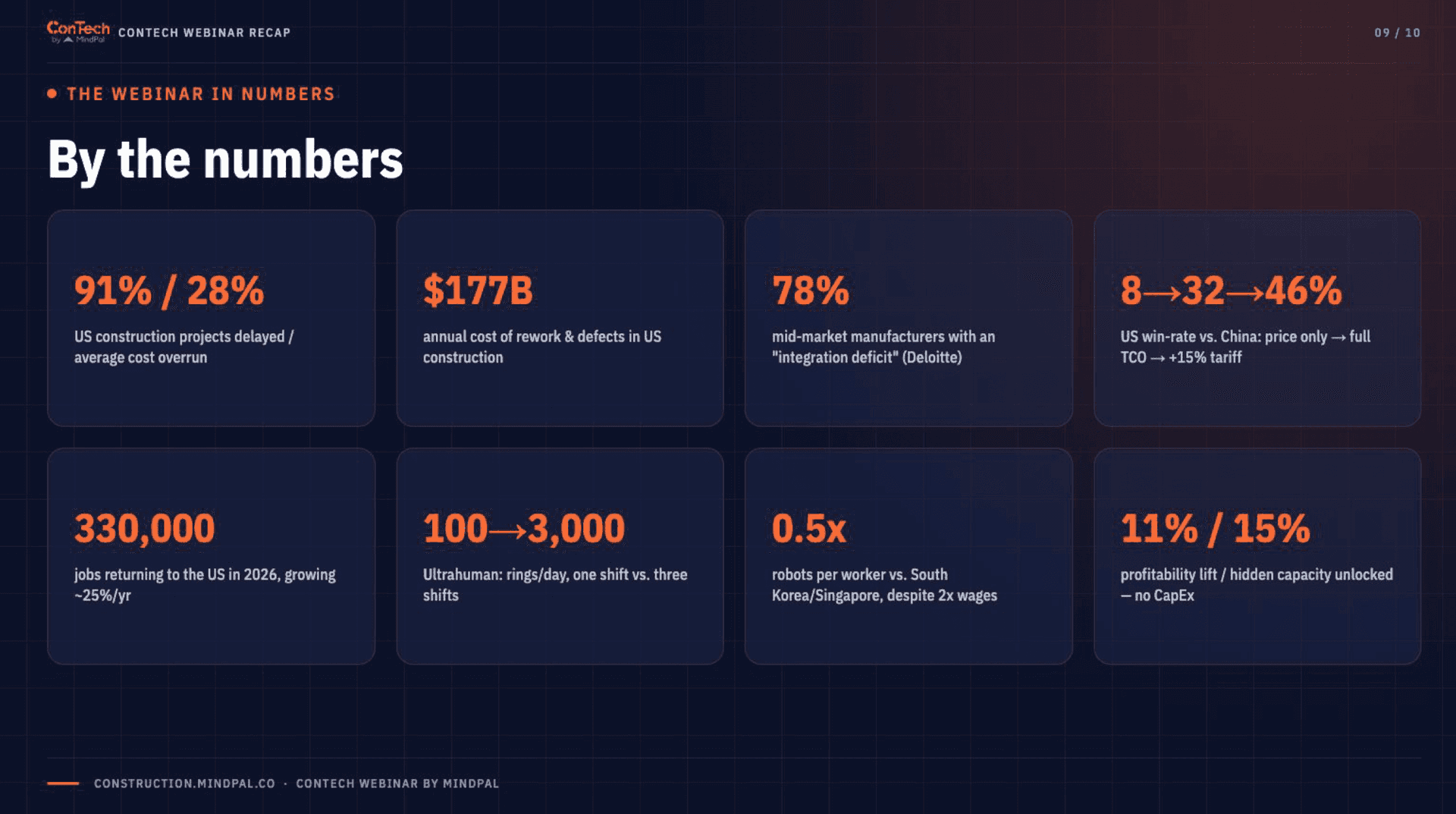
Despite these hurdles, the momentum behind reshoring is moving at an unprecedented pace. The Reshoring Initiative tracked just 11,000 returning jobs in 2010; by contrast, the 2026 forecast stands at 330,000 jobs—a run rate compounding at roughly 25% year-over-year.
Re-calculating the Sourcing Math
According to Moser, the catalyst for this shift is data-driven transparency. When companies move past simple piece-part pricing and utilize the Reshoring Initiative’s free Total Cost of Ownership (TCO) calculator, the financial math fundamentally changes. Factoring in duties, freight, and supply chain volatility shifts the US win-rate against China from a meager 8% on raw price alone up to 32% on full TCO—and all the way to 46% when a 15% tariff baseline is factored in. Furthermore, 40% of B2B buyers openly admit they would pay a 5% to 20% premium for one-week delivery over a six-week lead time from China, simply to carry less inventory and insulate themselves from risk.
Dr. Pavan Kumar provided a tangible case study of this data in action. Ultrahuman successfully reshored its advanced smart ring production from India to Texas, optimizing for the state's technical talent pool and supportive regulatory framework. Currently, a team of 100 operators produces 700 to 800 premium rings a day on a single shift at an 80% yield, with clear infrastructure scaling pathways to reach 3,000 units a day across three shifts. However, Kumar noted a critical structural challenge: certain core raw inputs, such as custom batteries and titanium shells, are not yet produced natively in the United States, meaning full reshoring remains a highly complex supply-chain puzzle rather than an overnight transition.
2. The Visibility Gap: Where Factories Lose Money Between Office and Line
The panel then pivoted to internal operations, mapping out exactly where mid-market manufacturers drop visibility and bleed margins.
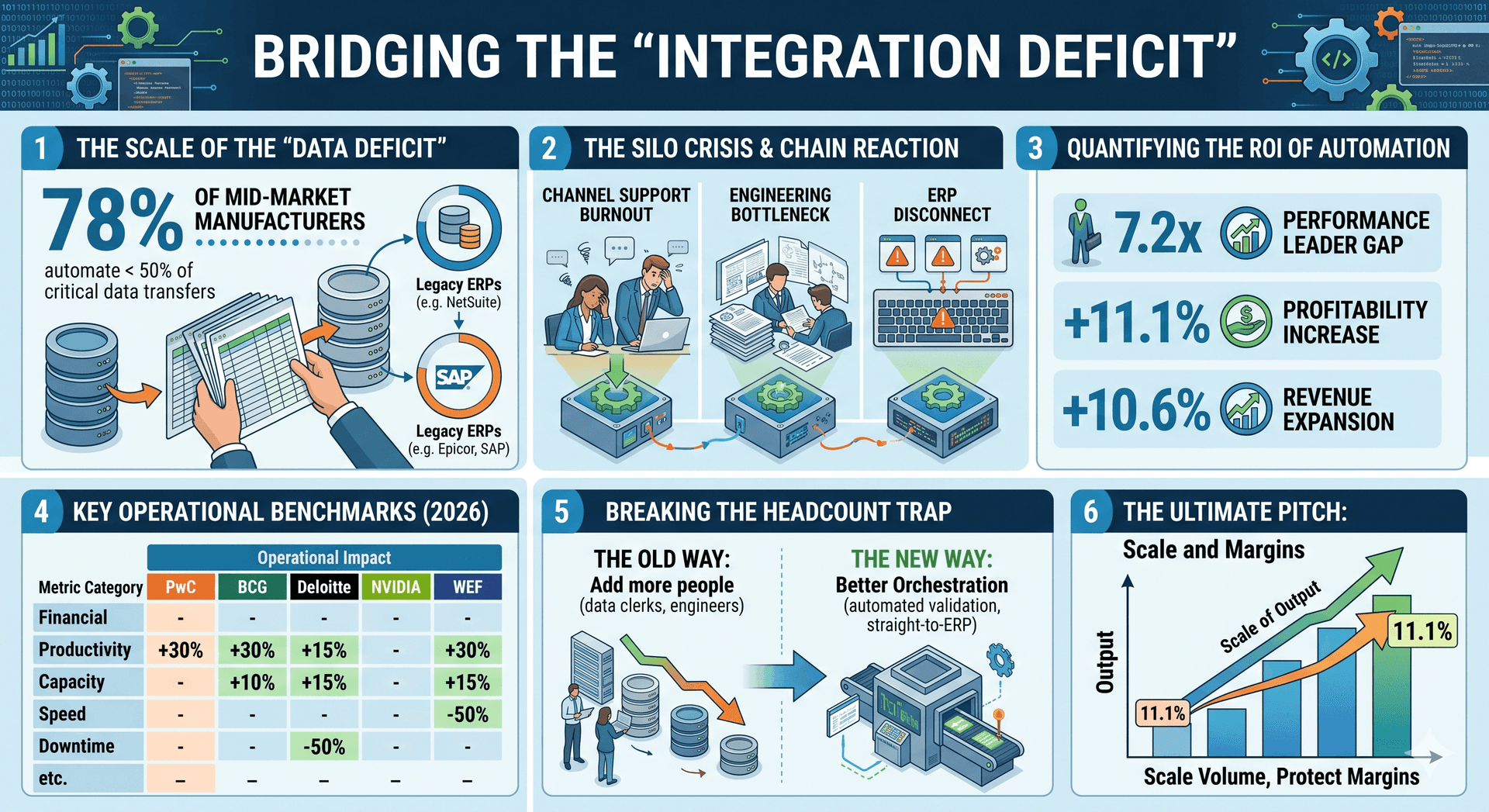
Dr. Kumar isolated a common industrial blind spot: the structural gap where highly automated processes connect directly to manual handoffs. At Ultrahuman’s facility, the high-tech PCB assembly stage (SMT) operates at a highly optimized 98-99% automated tracking accuracy. However, the subsequent mechanical assembly stages—such as soldering, polishing, and casting—are predominantly manual and largely untracked.
When daily production yield drops, an operations team without live data tracking cannot execute an immediate root-cause analysis. The resulting delays bleed work-in-progress (WIP) inventory, material, and valuable labor hours. For precision micro-hardware, the margin for error is non-existent. A single tired or undertrained operator can tank a line's yield in hours. Implementing computer vision and automated barcode tracking isn't a modern luxury—it's the only baseline mechanism capable of catching an active anomaly in minutes rather than discovering it at the end of a shift.
Front-Office Automation Impacts the Shop Floor
Harry Moser countered with an example from the front-office side of the equation. He highlighted a progressive machine shop that leveraged automation to compress its dealer quoting turnaround from an entire week down to under an hour. Because the vendor who delivers the first accurate quote to a customer wins the business a vast majority of the time, this speed directly translates to top-line growth.
The same facility automated its CAD-to-CAM translation workflows and standardized its workholding architectures. The result? The shop successfully transitioned from a traditional 1-to-1 operator-to-machine ratio to an optimized configuration where one operator oversees five machines simultaneously. This massive leap in administrative and operational efficiency allows domestic shops to aggressively compete against overseas labor costs that sit at a fraction of US wages.
3. Practical AI ROI: Skip the Hype, Target the Waste
To ground the final segment of the discussion, host Chris Parjaszewski introduced benchmark data from PwC’s 2026 AI Performance Study. The findings highlight an elite tier of operational leaders outpacing digital laggards by a staggering 7.2x performance gap—capturing a combined +700% in revenue and margin gains. These automation-first companies see an 11% profitability lift solely from eradicating administrative waste, alongside a 15% capacity boost unlocked from their existing machinery without any capital expenditures on new equipment.
When asked where resource-constrained operations leaders should point their first automation dollars, the panelists laid out a practical framework.
The Moser Blueprint for High-Value Automation:
- High Labor Content / Established Automations: Target processes where automation architectures are mature and manual labor steps can be safely minimized (e.g., robotic apparel or assembly cells).
- Globally Competitive Materials: Lean into materials like plastics that currently hold a distinct global cost advantage over tariff-impacted metals like steel and aluminum.
- High Import Friction Categories: Focus on components or goods protected by local tariffs, subject to seasonal or volatile demand shifts, or inherently expensive to transport across ocean lanes.
- Component Sourcing: OEMs typically transition component parts back home long before migrating entire final product assemblies, creating immediate compound demand spikes for tier-1 and tier-2 domestic component suppliers.
Moser concluded with a strict caveat on AI implementation: advanced models are completely dependent on synchronized internal networks and clean data inputs across departments. Operating in isolated data silos will inevitably yield a "garbage in, garbage out" bottleneck, regardless of how advanced the underlying model is.
Pragmatic Augmentation vs. Autonomous Control
Dr. Kumar brought the AI debate back down to the reality of the plant floor today, clarifying that current operations rely heavily on focused machine learning designed to support human teams, rather than autonomous AI making top-level manufacturing calls.
Because production lines carry real financial and legal liability, a human manager must sign off on critical operational choices. However, the path forward is clear: near-term automation strategies should rely on software to handle repetitive, low-risk workflow logic, while humans retain control over high-stakes, cost-sensitive choices. The ultimate metric of a successful automation rollout isn't about chasing cheap labor trends—it is about maximizing yield, cutting material waste, and reclaiming lost margins.
Tom Teluk
PR, Communication Head
tom@mindpal.co
To download the complete technical brief of the roundtable discussion or to apply for a complimentary workflow automation audit for your facility, visit construction.mindpal.co or submit your operations brief at construction.mindpal.co/webinar-form.